
Click here to read the previous post Adjusting to Life in Spain: My First Spanish Christmas
I’ve lived in Spain for about a year and a half and, with my four years of Spanish lessons, assumed that by now I would be fluent. Not bilingual, but decently fluent in Spanish.
Has that happened? ¡Ni de puta coña!* (And, yes, I had to look that up because I still don’t speak fluent Spanish!!)
I’ve also been dating a Spaniard for about a year, and not only do we speak Spanish (and English, because he wants to improve his second language, too), but he happily answers all my grammar and vocabulary questions and teaches me the correct Spanish slang and Spain-specific colloquialisms.
And still I can’t understand spoken Spanish. (Ok, mature-person disclaimer: sometimes I can, but only when the person speaks clearly and moderately slowly.)
Anyone who knows me knows that I am an introvert who is sensitive and prone to overwhelm faster than you can say “Wha–?” So being thrust into social situations in which everyone speaks Spanishsuperfastandwithouttakingonefuckingbreathbetweensentences has been rather… hard, shall we say. <flashback to recent meltdown with tears and full body shakes>
My boyfriend has learned how to care for me in these situations and soothe me and help bring my overwhelm down from DEFCON 1 to DEFCON 5:
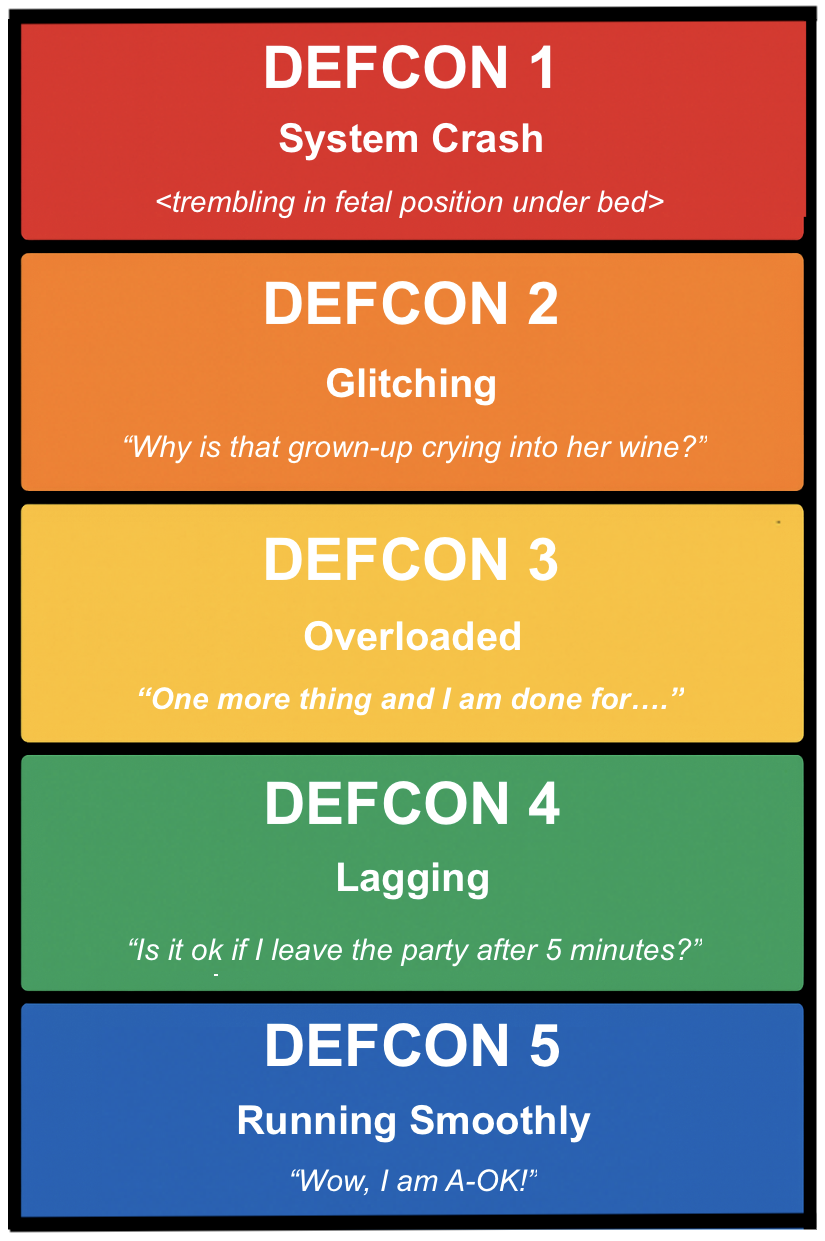
But that shouldn’t be his job. Or, rather, he can volunteer to do that job (and I love him for always volunteering), but I need to find a better coping method than bursting into tears and yelling, “I feel so stupid! Why don’t I understand a single thing they’re saying?!”
Why I Can’t Understand Spoken Spanish—Especially in Groups
I have two hour-long Spanish classes each week with a native Spaniard, and I understand her very well. Not perfectly, but enough that we have actual conversations about real-life things. Our Monday class usually entails her asking me how my weekend was, and after I tell her, she shares her weekend with me. No problem.
I also spend vast amount of times with my boyfriend, another native Spaniard, and I understand him very well. Again, not perfectly, but enough that we also have all sorts of interesting conversations in Spanish.
But the moment another person enters the conversation – his son, his friend, a waiter – I lose all ability to understand even one word. Okay, sometimes one word, but never the whole dialogue. And when “another person” turns into “a group of people”? Forget it. It’s all Greek to me. (Or, should I say, “It’s all Spanish to me.”)
Native speakers speak their language fast, often don’t enunciate, and use slang. They mention names I don’t know, customs I don’t get, jokes I can’t catch.
In one of my quests for “why can’t I fucking understand Spanish?!?” I discovered a scientific reason why it’s much harder for learners to grasp spoken Spanish.
English is a stress-timed language.
This means that you speed up and slow down around stressed syllables.
For example: “The parents buy the books.” 6 syllables, yes, but only 3 beats in spoken English. Why three beats? Because:
Content words (where the beats happen): parents, buy, books
Function words: the, the
Even when you add more syllables – “The parents will have been buying all of the books” – you still only have 3 beats. The PARENTS will’ve been BUYING all’ve the BOOKS.
Spanish is a syllable-timed language.
This means that the time between each syllable is pretty much the same. There’s no distinction between content (“important”) words and function words.
So the Spanish translation of the above example – “Los padres habrán estado comprando todos los libros” – has 16 equal syllables.
Therefore, what the ear hears is 3 defined beats in English versus 16 equal (and, sometimes, monotonic) syllables in Spanish to communicate the same thing. Which means: 16 beats is harder to take in than 3 beats.
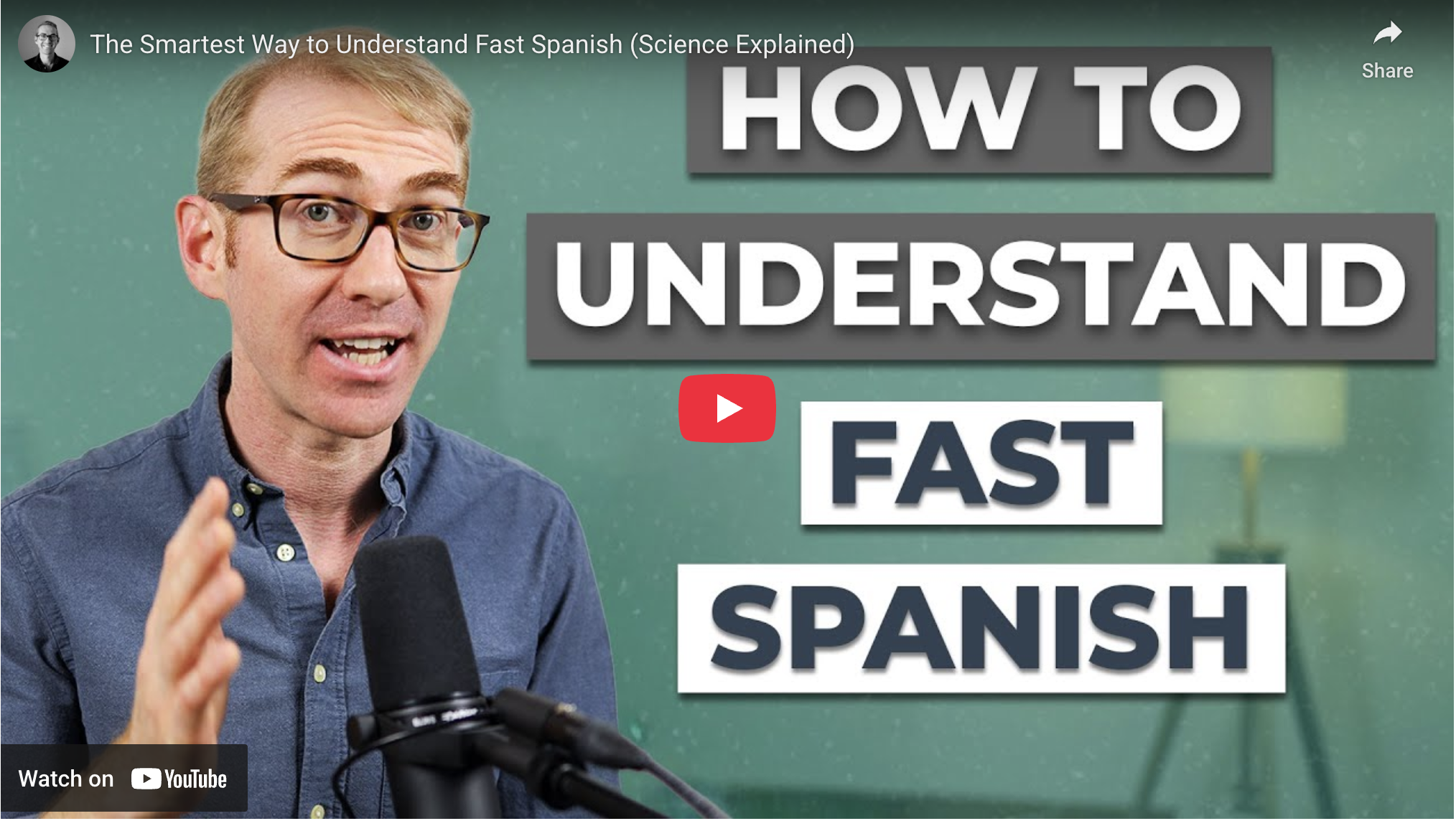
This information was very helpful to me, which I learned from this great video:
The Smartest Way to Understand Fast Spanish (Science Explained)
Here’s What Helps Me Cope in These Social Situations
Often in social situations where everyone is speaking Spanish, my boyfriend will turn to me and say, “Understanding anything?” To which my answer is, inevitably: “Not one fucking word.” He will usually translate for me — and I’m so grateful for his patience and care — but he can’t always be my translator, and nor do I want him to be. Sometimes he just wants to enjoy the conversation with his friends or family.
So I’ve had to really figure out a way to deal with these moments. I could choose not to go out with him and his friends or not participate in an evening at home with his family, but A) even this introvert needs to be around other people sometimes!, B) I want to get to know his friends and family better, and C) avoiding these situations is not going to improve my Spanish.
So, first, I had to shift my mindset and realize that in these environments, my job is not to understand the group conversation. My job is to stay emotionally regulated (did I mention the tears and breakdowns?) and socially “present enough.” That’s it.
Here are a few “tools” I’ve put together to help me cope in these verbal-Spanish social situations:
1) Prepare myself before gatherings
If I know I’m going into one of these social situations where I’m likely to feel frustrated and overwhelmed, I can try to prepare myself beforehand:
Ask my boyfriend who will be there
Look up 10 words/phrases related to likely topics (work, kids, travel, football, food)
If they’re from a specific region, listen to 5 minutes of that accent on YouTube

2) Reduce the overwhelm in the moment
When I can’t understand Spanish in those social situations, my brain often interprets it as social danger (“I don’t belong” / “I’m invisible” / “I don’t matter”). The goal here is to interrupt that interpretation. While in the situation, for example at the table in a restaurant with others, I can do a silent, 60-second reset:
Plant both feet on the floor. Loosen shoulders.
Slow exhale (longer out than in) 5–6 times.
Tell myself internally: “This is exclusion-feeling, not actual rejection.”
Give myself a time box: “I can do 10 minutes of this.” (Time boxes calm the nervous system.)
3) Be “pleasantly occupied” instead of fucking lost
The worst part is sitting there with nothing to do when the conversation is about other people, places or experiences (not that I would know that, given I don’t understand a damn word; this is what my boyfriend sums up for me later).
What I can do is turn my lack of linguistic understanding into a (private) game that still looks “normal” socially, such as:
A. The observer game
Notice 5 details: décor, music, what people are ordering, a funny gesture
Identify 3 new words I hear (even if I don’t get the context). Write them on a napkin for extra fun. If someone asks me what I’m doing, respond, “I’m tracking who interrupts who. Keep talking.” or “I’m drawing a map of how to escape this goddamn lunch.”

B. The micro-task game
Study the menu and find something interesting (whether or not I order it).
Ask the server a question. Preferably something that requires several follow-up questions. Whether or not I understand the answers, at least I won’t just be sitting there staring at the table.
Take a photo of the menu/wine list to translate later.
Someone even suggested I just pull out a book and start reading. Love that idea, though it might seem a little anti-social. On the other hand, if they’re all speaking rapid-fire Spanish without considering my inability to participate, maybe they’re the ones being anti-social….
C. The “social host” game
This is for when the socializing is at our home. Even if I don’t understand everything, I can still pretend to be warm. This matters because it stops my brain from going, “I’m not part of anything!”
Smile, nod, react to tone (easy-peasey – this is my default reaction anyway)
Give small interjections: “¡Qué bueno!” (Excellent!) “¡Qué fuerte!” (Wow!) “¡Madre mía!” (Oh my god!)
Use my body language to stay present: lean in slightly, make eye contact, don’t shrink back.
4) Use “low-burden bridges” that don’t require full translation
I don’t always need my boyfriend to translate everything. He can give me a quick anchor so my brain isn’t free-falling in the conversation, something I can grab onto so I’m not completely lost, like:
A quick summary (“He’s asking if we want red or white wine.”)
One key phrase I recognize (“She’s using the subjunctive: Remember: Si tuviera dinero…”)
The topic (“They’re talking about Spanish politics.”)
The outcome (“We ordered two tapas and the paella.”)
5) Create 2–3 “safe topics” I can always steer to
It’s not always possible in groups, but when it’s me, my boyfriend and his friend, I can manage to ask one simple question. Then I just listen for keywords, not even full sentences. I can better understand their answer when I know the context, when I know what type of answer to expect. Some simple questions:
“¿De dónde eres?” (Where are you from?)
“¿Cómo os conocisteis?” (How did you two meet?)
“¿Qué tal tu fin de semana?” (How was your weekend?)
“¿Cuál es tu bar/parque/cine favorito?” (What’s your favorite bar/park/movie theater?)
“¿Qué me recomiendas pedir?” (What do you recommend I order?)
6) Have an “exit-with-grace” plan that doesn’t look dramatic
If I do feel myself on the verge of tears, I don’t need to force myself to sit there melting down. Some subtle exits can be:
Take a bathroom break
Step outside for air (and if necessary, say I have to take a call)
Say “I’m going to grab a drink”
Then when I got to the bathroom, do an emotional regulation trick like run cold water on my wrists, do 10 slow exhales. Come back to the table when I feel more grounded.

7) Reframe the goal: I’m not trying to understand everything
In a large Spanish group, “keeping up” is unrealistic even for many advanced learners because of speed, overlaps, accents, and inside jokes. My goal should not be to understand 100% of the conversation and speak like a native (yes, I actually do expect this of myself) (now you know why I burst into tears in these circumstances). My goal should simply be:
Stay for just 10 minutes (then leave and come back)
Catch just 10% (names, places, emotional tone)
Connect with just one person for 5 minutes
Identify just 3 words
Leave having had just one pleasant moment
If I can do these simple things, then I think I can consider that a success. I mean, honestly, if I catch even 20% and don’t spiral, that’s basically bilingual.
By the way, if you’re trying to learn Spanish – whether you live in or are planning to move to Spain or not – I highly recommend Laura, my Spanish teacher. She’s so lovely and easy to spend time with, and she can adapt her teaching method to whatever level you are at, or whatever goal you are trying to achieve.
* ¡Ni de puta coña! = No fucking way!
Click here to read the next post, Adjusting to Life in Spain: Road Trip Through Spain & Portugal (pt. 1)
Note: All photos taken or created (using DALL-E) by Selena Templeton, unless otherwise noted.
If you enjoyed reading this travel blog, check out some of my other adventures:
Adjusting to Life in Spain: Dating in My Non-Native Language
Adjusting to Life in Spain: Using the Spanish Healthcare System
Adjusting to Life in Spain: Damn, I Can’t Find My Favorite Products Here!
From Fiesta Invites to Flamenco Nights: My Adventure in Spain
My Road Trip to the Four Corners: Utah, Colorado, New Mexico, Arizona
